Issue
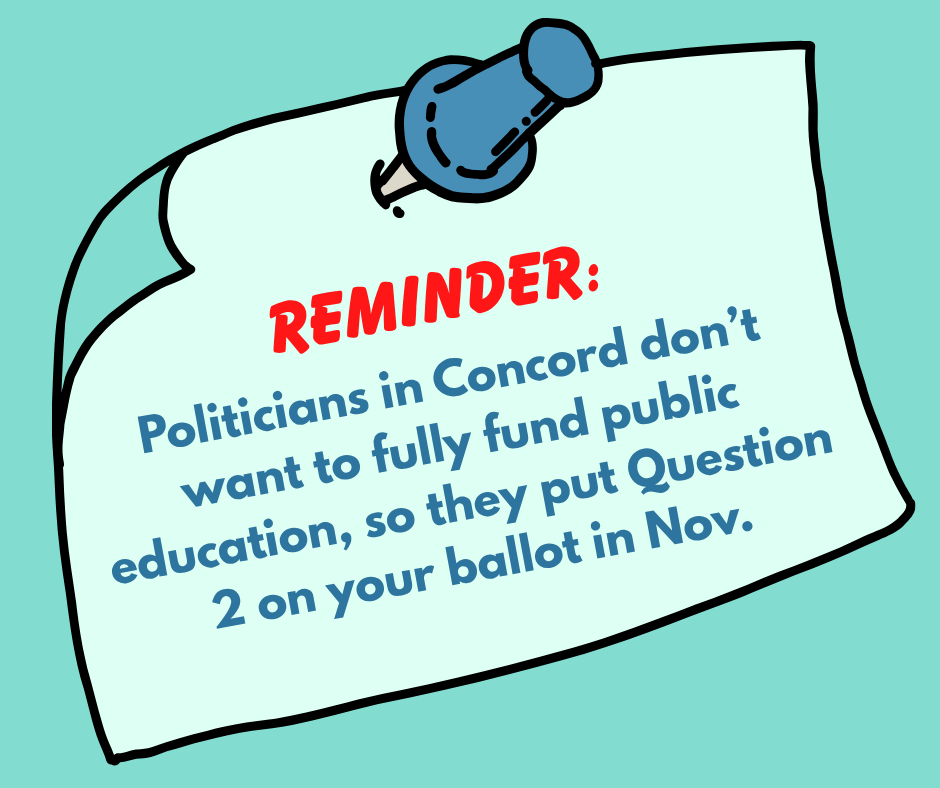
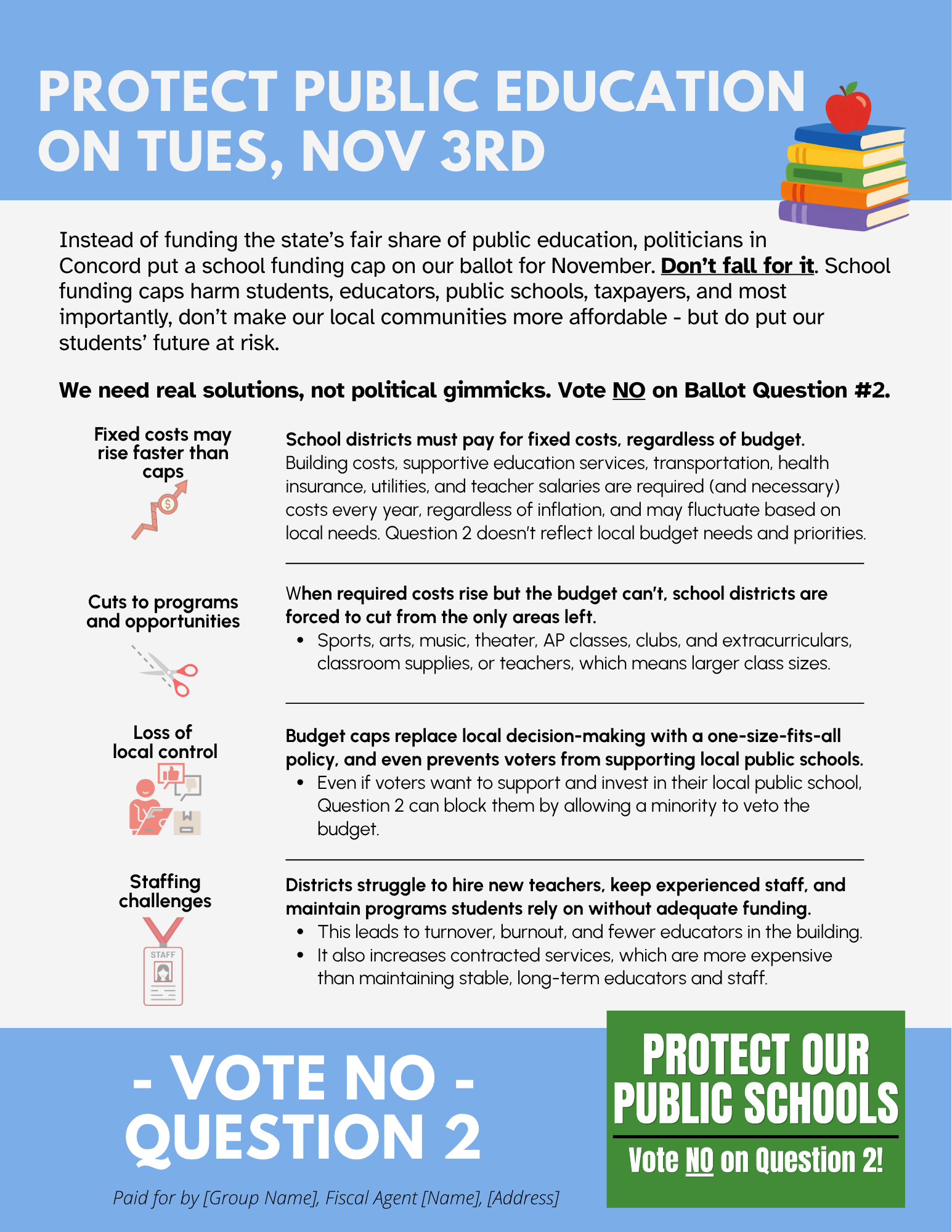
Instead of funding the state’s fair share of public education, state politicians in Concord put Question 2 on our November ballots. School funding caps harm students, educators, public schools, and taxpayers. Most importantly, they don’t make our local communities more affordable - but they do put our students’ future at risk.
We need real solutions, not political gimmicks. Vote NO on Question 2.
Background
During the November 2026 and November 2028 state general elections, every town and ward in a city shall conduct a vote on a local tax cap question for their school district and a fixed cap on the school administrative unit central office administrative budget.
The question shall appear on the ballot by operation of law and shall not require a warrant article, citizen petition, or separate local legislative approval.
Language on the Ballot
Annual school district meeting: “Shall the [name of municipality] limit property tax growth for [name(s) of school district(s)] under RSA 32:5-i? If adopted for a two-year period: (1) the local property tax levy may not grow beyond the prior year’s amount, adjusted for inflation and new construction; (2) SAU central office spending may not exceed 6 percent of total school district appropriations; and (3) bonded capital costs are excluded from both limits. These caps apply only to administrative operations of the SAU central office and do not affect classroom instruction, school-based services, or other municipal expenditures. These limits may be overridden as provided in RSA 32:5-i. Adoption requires a three-fifths (3/5) majority vote.”
Note: Many public school advocates have disputed the language that Question 2 will not affect classroom instruction, school-based services, or other municipal expenditures. It is impossible to guarantee this because cutting school funding harms all aspects of public schools — and Question 2 proponents are the same ones who have consistently cut funding and support for public schools.
Open Questions
This ballot question is confusing, wordy, and contradicts itself. A few of the very real questions and concerns still unanswered:
It doesn't account for enrollment growth. If a district gains school-aged kids, Question 2 won’t give schools the resources they need to educate them, like additional teachers, supplies, or classroom space.
Nobody's sure what it means. The bill was written so sloppily that even basic terms are unclear – the State’s own agencies haven’t defined what “net taxable revenue” or other key terms mean under the law. And, making clarifying rules takes time - often months. Will they be ready in time for school board members and community members to craft their local budgets?
Can voters even repeal it? Unclear – and it looks like the answer may be no.
What happens to schools already struggling? Not every school district has room to absorb a cap. Claremont's Bluff Elementary School nearly closed. Franklin's latest compliant tax cap budget could cut art, music, and computer teachers, over a dozen other positions, and athletics entirely. Some communities can weather this short-term — others have no margin left to hold on.
Even school boards don't have answers yet. They're building budgets right now with the same open questions — often the honest answer is : ‘we just don't know yet.’
Major Problems with Question 2
Fixed costs may rise faster than caps
School districts must pay for fixed costs, regardless of budget. Building costs, supportive education services, transportation, health insurance, utilities, and teacher salaries are required (and necessary) costs every year, regardless of inflation, and may fluctuate based on local needs. Question 2 doesn’t reflect local budget needs and priorities.
Cuts to programs and opportunities
When required costs rise but the budget can’t, school districts are forced to cut from the only areas left. Sports, arts, music, theater, AP classes, clubs, and extracurriculars, classroom supplies, or teachers, which means larger class sizes.
Loss of local control
Budget caps replace local decision-making with a one-size-fits-all policy, and even prevents voters from supporting local public schools. Even if voters want to support and invest in their local public school, Question 2 can block them by allowing a minority to veto the budget.
Staffing challenges
Districts struggle to hire new teachers, keep experienced staff, and maintain programs students rely on without adequate funding. This leads to turnover, burnout, and fewer educators in the building. It also increases contracted services, which are more expensive than maintaining stable, long-term educators and staff.
We need real solutions, not political gimmicks. Vote NO on Ballot Question #2.